RE
Revolut

The growing library of engagement and retention mechanics for finance product teams. Documented from real apps, with three new breakdowns every week.
Revolut

Monzo

Chase

Monefy

Monarch

Binance

Acorns

Cash App

Cleo
Your card competes with two others at every checkout.
The question is never whether your card is good. It is whether it is the one a customer reaches for without thinking. Habits like that grow from a small, renewing reason to return, the kind a good game offers every single day.
Customers want to save and mostly don't.
Wanting to save and actually saving are separated by a gap that is old and stubborn. The way across it is something game design leans on constantly: break a distant goal into steps small enough to feel doable, and make each step visible enough to feel like progress.
Education that feels like homework gets ignored.
People rarely set aside time to learn about money, so the lesson has to come to them. The best games teach inside the activity itself, one small idea at the moment it is useful, with progress the learner can actually see.
Customers will change jobs more often than they'll change banks.
The account a customer never bothers to leave is one they have quietly invested in: their history, their progress, a sense of standing they would lose by walking away. That kind of earned attachment is exactly what game design is built to create.
Flat rewards get noticed once and then forgotten.
A reward changes behaviour only while a customer can feel it. Keep it visible and a little bit earned, a streak worth continuing or a milestone in sight, and the next purchase becomes something worth tracking rather than something to ignore.
The first session decides who stays past day one.
A nervous new user needs one clear thing to do, and one small win to feel it was worth doing. The opening minutes are where people quietly decide whether to return, which is why game design treats them with so much care.
Retention flattens, and nobody knows which feature would fix it.
Every engagement idea starts from a blank page.
Copying Duolingo's streak didn't work. Nobody knows why.
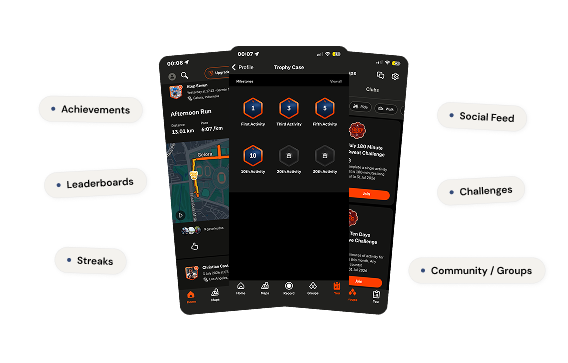
Every app, taken apart the same way: what it built, how it works, and when it would work in yours.
This is how Strava's mechanics hold together as one system.
Recording an activity is the hub the rest of the system runs on.
Explore the Strava mapYour users don't compare you to other banks. They compare you to everything on their phone.
Weekly updates with three new breakdowns, straight to your inbox. Subscribe and we will also send you our overview of the finance category and the apps leading it.
Working on a specific problem? Book an audit