A ranked list of users or groups ordered by a performance metric, making individual standing visible and publicly comparable.
Best for
Competitor
Context
Retention
Motivation drivers
CompetenceRelatednessMastery
How it works
Rank makes progress public and comparative
Rank is identity for the Competitor. They want to be visibly ahead of real people, and personal progress is not enough. Losing rank is painful. External stakes make every other mechanic feel more serious. The gap to the next position above becomes a goal; the threat of falling creates persistent return pressure.
Core principle
Rank makes progress public and comparative. The leaderboard converts personal achievement into competitive standing.
Watch out for
Leaderboards that show only the top 0.1% demotivate most users by making the gap feel insurmountable. Local or segmented leaderboards are more motivating for median users because the gap is closable.
Structural variants
Four ways to build it
01
Global leaderboard
02
Friend leaderboard
03
Clan/league leaderboard
04
Weekly reset leaderboard
Lifecycle placement
Mid-to-late lifecycle. Strongest once the user has enough investment to care about their position relative to others.
Case studies · 3
Seen in the wild
Capybara Go!Roguelite
How they use it
A global player ranking is visible from the profile screen, showing position alongside chapter progress and longest run metrics. During analysis the account reached rank 3,092 after three sessions across four days. The ranking uses chapter progress and longest survival run as the displayed metrics, making it a proxy for skill and time investment simultaneously. A Tower Challenge leaderboard ranks players by tower floor cleared.
Why it works
Using chapter progress and longest run as ranking metrics means rank reflects quality of play rather than raw time spent. A player who cleared Chapter 2 efficiently ranks higher than one who spent the same hours failing Chapter 1 repeatedly. This makes the comparison feel earned rather than arbitrary.
The detail
Global rank is visible on the player profile. Tower Challenge rankings show floor reached. Both leaderboards update in real time.
Takeaway
Rank 3,092 was reached after three sessions, early rank movement is fast, creating an immediate sense of competitive progress before the ranking stabilizes.
Head-to-Head matches operate within a weekly leaderboard: wins earn stars, losses remove one star, with promotion or demotion based on star count at week's end. Weekly leaderboard rankings show rewards tiered by final position (top 1, top 8, top 20). Manager Mode seasons last 15 days with a separate division ranking. The global league ranking shows top leagues by points, the top league held 1.7M points and a 128 OVR average during analysis. The analyzed account's league was ranked 19th of 20 visible leagues globally with 104 badges total, and the individual global ranking was 600,000th.
Why it works
The dual leaderboard cadence (7-day H2H and 15-day Manager Mode season) creates two parallel ranking pressure cycles running simultaneously. The global league ranking display communicates competitive position without masking the gap, 19th of 20, individual rank 600,000th is shown without softening.
The detail
The weekly Head-to-Head leaderboard is accessed from the H2H screen. The global league ranking is visible from the league hub with a toggle between group and global ranked views.
Takeaway
The global league ranking shows 19th of 20 leagues and individual rank 600,000th without softening, a transparent communication of competitive position that most apps would obscure.
screenshot
League leaderboard showing the user's league at position 19 in group, the top three leagues' point totals, and the group promotion/demotion structure
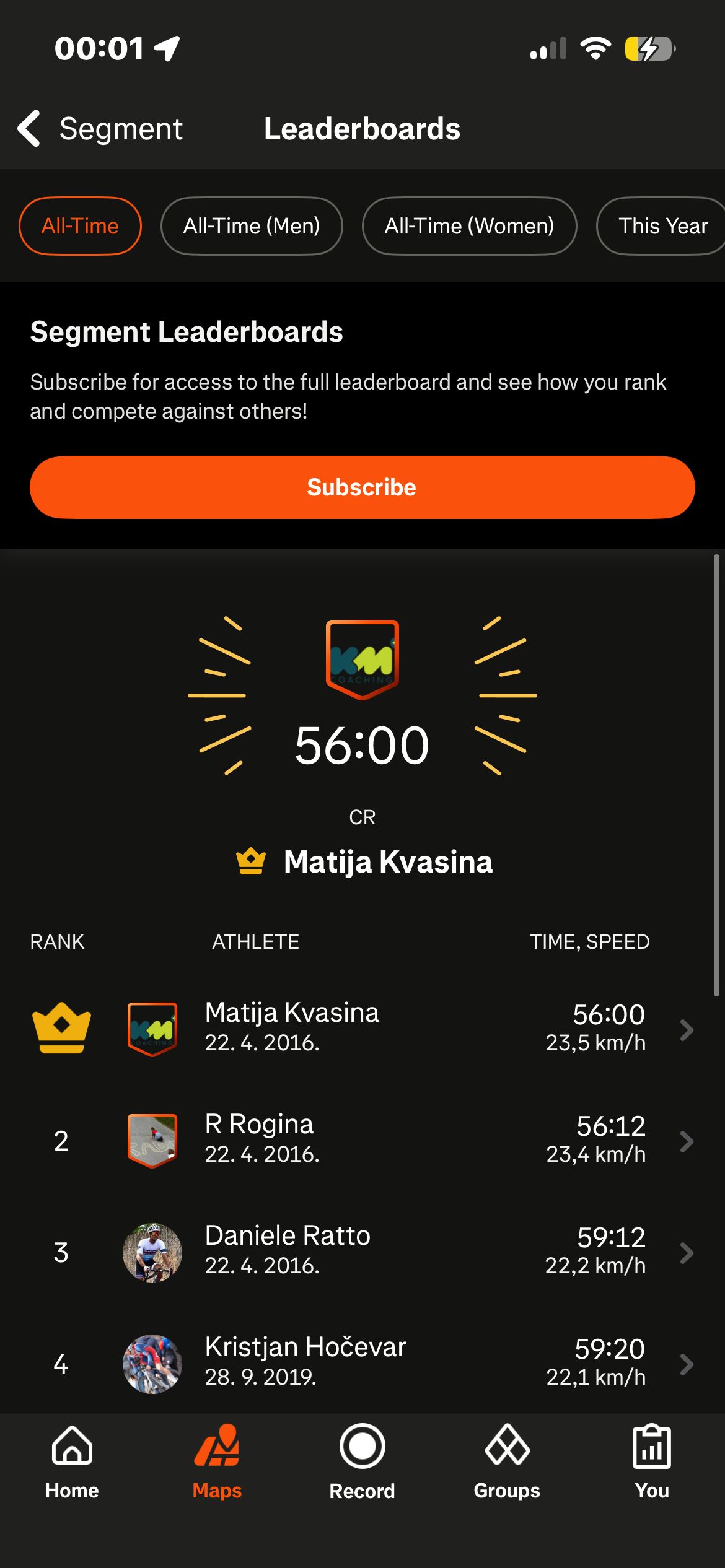
Strava scopes its rankings to a single stretch of road or trail rather than to the whole app, so a user is compared with the users who covered the same ground. Segments carry ordered lists of the users who have run or ridden them, and the app also states where a user stands personally. A Local Legend title marks holding the most efforts on a segment over the previous 90 days, a top 10 view collects the segments where the user places in the first 10, and CRs are the segments where the user holds the best overall time. Challenges carry their own leaderboards, ordering participants by the measure the challenge is built on, such as pace, distance, or steps. Strava also offers a notification for losing a top place, listed in settings as lost CR and lost ratings. Segment leaderboards and best efforts are available to subscribers, so we did not reach the full extent of ranking on a free account.
Why it works
Two different things run side by side here, and Strava keeps them apart. The ordered list shows the field, and the named standing states where a user sits in it. Local Legend is the more unusual of the two, because it ranks by how many times someone covered a segment over a rolling 90-day window rather than by how fast they covered it, which makes the top place on a segment a matter of repetition rather than speed. The lost place notification shows the standing is built to be losable, since another user's result can take it.
The detail
Rankings appear as ordered lists inside segment views and on each challenge page, with the measure the ranking uses shown beside each participant. A user's own position is presented separately as a named standing rather than only as a row in a list, with Local Legend, a top 10 collection, and CR holder attached to segments and to a 90-day window.
Takeaway
Strava scopes its rankings to individual segments, so the comparison set is the users who covered the same ground.
Each week we add three fresh breakdowns of how successful apps implement game mechanics. Get the most interesting mechanics from each, straight into your inbox.