Named groups with shared identity, shared history, and shared goals that users join and return to as members.
Best for
Socializer
Context
Retention
Motivation drivers
RelatednessPurposeAutonomy
How it works
Social obligation is a stronger retention force than product value
A named group with shared identity and history is the primary retention anchor for the Socializer. Members who might leave the app rarely leave their community. The group gives the user a reason to return that is interpersonal, not product-driven, they are showing up for people, not features.
Core principle
Social obligation is a stronger retention force than product value. The group creates a reason to return that the app itself cannot manufacture.
Watch out for
Groups require active moderation and seeding to avoid becoming ghost towns. An empty or quiet group is worse than no group, it confirms the social experience is not worth having.
Structural variants
Four ways to build it
01
Public clubs
02
Private groups
03
Interest-based communities
04
Local groups
Lifecycle placement
Long-term value. Groups become more valuable the longer the user is a member.
Case studies · 2
Seen in the wild
Insight TimerWellness
How they use it
7,000+ groups cover Buddhism, poetry, psychology, weight loss, LGBTQIA+ communities, and more. Groups are accessible through the sidebar rather than any primary navigation tab, a user who explores only the five primary tabs will not find them. Live events are free-to-attend digital events with real-time attendee counts. A Therapist Directory lists 42,000 therapists globally, filterable by country and specialty. A Retreats marketplace lists 500+ real-world experiences from $50 to $11,452.
Why it works
7,000 groups with combined active membership means no niche interest goes unrepresented. The breadth makes Insight Timer hard to replace for a user invested in a specific community. The de-emphasis in navigation may reflect a deliberate choice to surface groups to users who seek them out rather than to all users.
The detail
Groups are in the sidebar, not primary navigation. Live events show teacher name, topic, attendee count, and scheduled time. The real-time engagement counter ('594,622 people here today, 21,416 right now') is visible on the home screen.
Takeaway
Groups are hidden behind the sidebar with no presence in the five primary navigation tabs, a significant community infrastructure deliberately de-emphasized in the main navigation.
screenshot
Browse groups view showing type filters (writing, LGBTQIA+, women only, psychology) and popular groups with member counts (Be Here Now 200,000+)
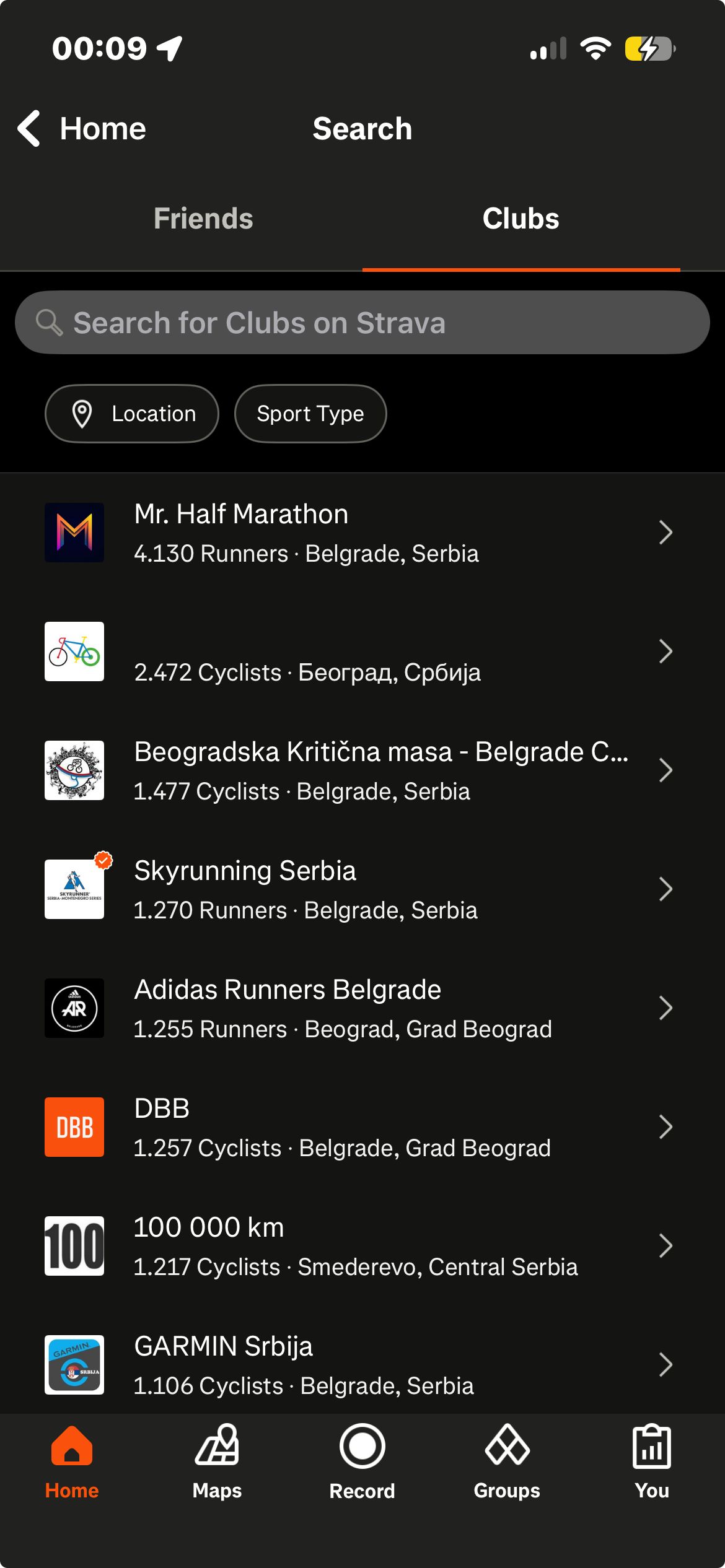
Strava lets any user create a club and gives the creator the controls that decide who gets in. The creation flow runs through 5 steps, choosing the club's sport, picking up to 3 tags describing what the club is for, such as local community, team, or coach led, setting the name, photo, and description, choosing whether the club is public or private, and setting a location. A private club requires users to request permission, and only admins approve new members. Clubs are found through a searchable directory filtered by location and sport, which returned dozens of clubs in the area we searched, and their sizes range widely, with the main Strava club listing almost 7 million members. A club page shows its sport, member count, type, events, activities, stats, and posts, and members can create club events with attendance controls. Creating a group challenge inside a club is available to subscribers.
Why it works
The governance controls are the part worth noticing. Strava does not only let a user join a club, it lets them run one, and the private setting with admin approval gives a club a real boundary rather than a label. The tags cover a wide range of purposes, from local community groups to teams, brands, and coach led groups, so one structure serves several different kinds of gathering.
The detail
Clubs appear as a tab in search and as their own area under Groups, presented as a browsable directory. Each club carries a member count and its public or private state, so the size and the entry rules are visible before joining. The creation flow gives the public or private decision its own step, with the consequence stated on that screen.
Takeaway
Any user can create a club, and the creation flow includes the decision of whether membership is open or requires admin approval.
Each week we add three fresh breakdowns of how successful apps implement game mechanics. Get the most interesting mechanics from each, straight into your inbox.